In 2012, Nathan Barry was a designer in Boise, Idaho who had never written a book. He decided to write one about web app design, sell it directly to his small blog audience, and see what happened. Barry’s made $12,500 in the first twenty-four hours. He wrote two more. He made $250,000 from three self-published books. Then he decided to build the software he wished had existed when he was selling those books.
That software became ConvertKit, which became Kit, which in 2026 has approximately $45–50 million in annual recurring revenue and serves over 700,000 creators globally. Nathan Barry net worth is estimated between $40 million and $60 million, built almost entirely from his founding equity in a company he has run without venture capital and without losing majority control for over a decade.
The Number and the Honest Methodology
Nathan Barry net worth in 2026 is estimated between $40 million and $60 million, based on Kit’s confirmed ARR trajectory, Nathan’s founding ownership stake estimated at approximately 50%, and cross-referenced SaaS company valuation benchmarks.
The calculation requires understanding how SaaS equity wealth works. Kit generates approximately $45–50 million in annual recurring revenue as of 2026. A B2B SaaS company with that ARR, strong net revenue retention, and a loyal creator audience typically trades at 5x to 8x ARR in the current private market. At 5x ARR, Kit’s total valuation sits at approximately $225–250 million. Nathan’s 50% stake would be worth $112–125 million at that multiple.
The $40M–$60M personal net worth estimate is more conservative than the paper equity figure for an important reason. SaaS founder wealth is almost entirely illiquid until a sale or public offering. Nathan cannot spend his equity stake on Monday morning. The liquid portion of his wealth, accumulated through profit distributions and his earlier publishing income, sits lower than his paper equity position. The honest personal net worth estimate reflects accumulated liquid and near-liquid assets rather than the theoretical maximum of a favourable exit scenario.
He has never sold the company. He has never raised institutional venture capital. Every dollar of his equity value has compounded from a $5,000 initial investment he made to build the first version of the product himself.
Who Is Nathan Barry
Nathan Barry is an American entrepreneur, author, and software founder. He is the CEO and founder of Kit, the email marketing and creator business platform formerly known as ConvertKit, which serves over 700,000 creators, writers, podcasters, and online educators globally.
Before founding Kit, he was a self-taught designer and author who built an audience by teaching design skills through his blog, then converted that audience into customers for self-published digital books. The $250,000 he earned from three books in 2012 and 2013 proved to him that the creator economy was real and that the software infrastructure serving it was inadequate. He built Kit to fill that gap.
Nathan Barry’s lives in Boise, Idaho, with his wife Charli and their children. He has been deliberate about keeping his family life private relative to his public business presence. Boise has become his long-term home rather than a temporary stop. Nathan Barry is an American entrepreneur, author, and software founder. He founded and leads Kit as CEO. Kit was previously known as ConvertKit. The platform serves over 700,000 creators, writers, podcasters, and educators worldwide.
Barry taught himself design before launching Kit. He built an audience by sharing design knowledge through his blog. He later sold self-published digital books to that audience. Those books earned about $250,000 in 2012 and 2013. Their success confirmed the creator economy’s potential. He founded Kit to solve creators’ email and business challenges.
Nathan Barry lives in Boise, Idaho, with his wife, Charli, and their children. He keeps his family life largely private. He chose Boise instead of relocating to Silicon Valley. That decision reflects his personal values and bootstrapped business philosophy. A San Francisco relocation, a choice that reflects both personal values and a bootstrapped business philosophy that does not require Silicon Valley proximity to execute.
Boise, Design Books and the $12,500 Launch That Changed Everything
Nathan Barry grew up with a strong interest in design and technology. He is largely self-taught as a designer, learning through practice and publishing rather than through formal education in a traditional design programme. His early career was built around teaching what he learned through his personal blog at nathanbarry.com, where he wrote about design, productivity, and building internet businesses.
In 2012, he wrote The App Design Handbook, a practical guide for designers building mobile applications, and launched it directly to his blog audience. The $12,500 he made in the first twenty-four hours was not the result of a large audience or a major marketing campaign. It was the result of a small audience that trusted him enough to pay immediately. He followed it with Designing Web Applications and Authority, a book about building an audience and launching products. The three books combined generated approximately $250,000 in revenue.
That experience taught him something specific. He knew exactly how hard it was to manage an email list, sell digital products, and track what was actually working, because he had done all of it himself using tools that were not built for his situation. Mailchimp existed. AWeber existed. None of them were built around the specific workflow of a creator selling digital products directly to an email list. He started building Kit to solve his own problem.
The ConvertKit to Kit Rebrand: Why It Matters Financially
In 2023, Nathan Barry rebranded ConvertKit to Kit. The decision was not cosmetic. It reflected a genuine strategic shift in how the company positions its product.
ConvertKit was built as an email marketing platform for creators. The name described a tool. Kit is positioned as an operating system for creator businesses, covering email, automation, landing pages, commerce, recommendations, and the full infrastructure a creator needs to run a professional online business. The name change signalled that ambition to existing customers, potential customers, and the broader creator economy ecosystem.
The rebrand matters for the net worth story because it reflects the platform’s revenue expansion beyond email subscriptions alone. A creator business operating system with commerce, automation, and discovery features has a significantly larger addressable market than an email marketing tool. That expanded market opportunity justifies higher valuation multiples and higher long-term revenue projections, both of which compound directly into Nathan Barry’s equity value.
His rebranding instinct connects to how Dickie Bush and Nicolas Cole expanded Ship 30 for 30 beyond a writing course into the broader ecosystem of Typeshare and Premium Ghostwriting Academy, where the original product becomes the foundation for a larger platform serving the same audience at multiple price points and use cases.
Kit’s Business Model and Why It Compounds
Kit uses a freemium subscription model. Creators start with a free plan before upgrading. They pay monthly or yearly fees as their audiences grow. Kit bases pricing on each creator’s subscriber count. Its revenue grows as creators expand their email lists. This pricing model closely matches customer success. Larger audiences naturally increase each creator’s subscription cost. Kit earns more without additional sales efforts. The platform grows alongside its creators. That model reduces dependence on constant new customer acquisition.
Kit generates about $45 million to $50 million in annual recurring revenue. More than 700,000 creators use its free and paid plans. Free users often upgrade as their audiences grow. That process creates a steady customer acquisition funnel. Kit spends little extra on marketing for those upgrades. Net revenue retention measures customer spending over time. Growing creators increase their spending on the platform. That pushes net revenue retention above 100%. Industry analysts believe Kit maintains strong net revenue retention. Its pricing grows alongside each creator’s audience.
The same recurring revenue compounding logic that Pieter Levels built into his $40–60M bootstrapped portfolio through multiple SaaS products runs through Kit’s business model. Both generate revenue that grows as customers succeed rather than requiring constant new acquisition to sustain the baseline.
How Nathan Barry Makes Money
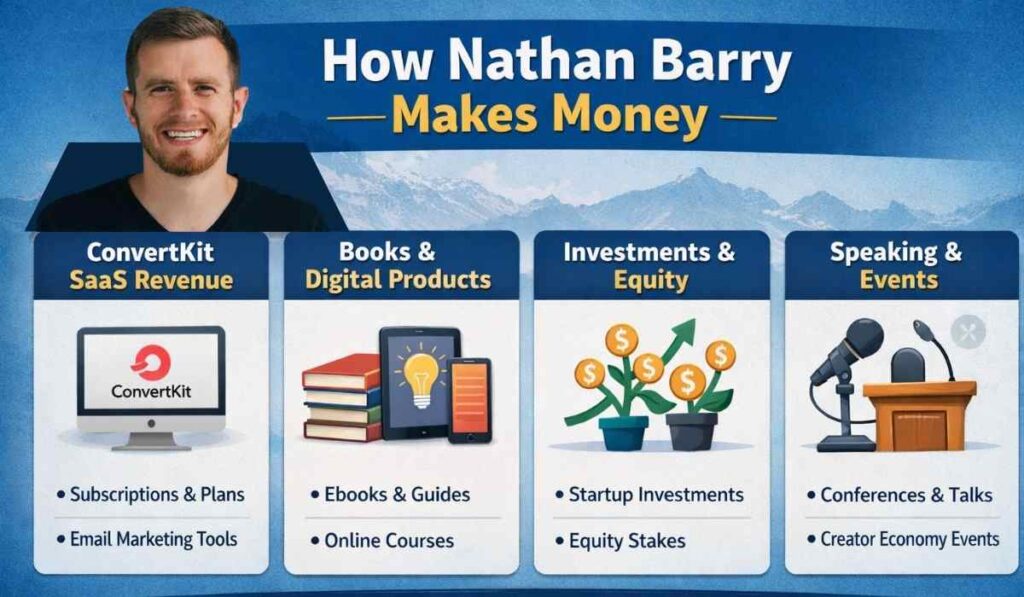
Kit is the dominant income source. As founding CEO with approximately 50% ownership of a company generating $45–50 million in annual recurring revenue, Nathan’s income comes through salary as CEO, profit distributions when the company’s cash generation allows them, and the compounding equity value that will crystallise at a liquidity event.
His early publishing business, while no longer his primary income source, continues generating modest royalty income from The App Design Handbook, Designing Web Applications, and Authority. Those books remain available and continue selling to new readers discovering his work through Kit’s profile.
Speaking engagements at creator economy conferences, podcaster summits, and SaaS founder events add income from his public profile as a bootstrapped founder who has scaled a company past $40M ARR without institutional capital. His story is sufficiently unusual in the SaaS world that speaking requests are consistent and the fees meaningful.
His podcast, formerly called The Nathan Barry Show and now focused on creator business topics, generates sponsorship income from companies targeting the same creator professional audience that Kit serves. The podcast functions both as an income source and as a brand reinforcement vehicle for Kit’s positioning in the creator economy.
| Source | Estimated Annual |
| Kit CEO salary and distributions | $3M to $8M |
| Publishing royalties | $50K to $150K |
| Speaking engagements | $100K to $300K |
| Podcast sponsorships | $100K to $250K |
| Total | $3.25M to $8.7M |
| Period | Estimated Range |
| Monthly Income | $270,000 to $725,000 |
| Annual Income | $3,250,000 to $8,700,000+ |
Kit’s Creator Economy Positioning in 2026
Kit competes with Mailchimp, Beehiiv, Ghost, and Substack. It focuses on professional creators instead of hobbyists. Professional creators build businesses with paid products and services. They generate more revenue for Kit than casual newsletter writers. Kit charges creators based on subscriber count. Successful creators pay more as their audiences grow. This pricing model creates stronger unit economics. The platform naturally attracts creators who already earn income.
Nathan Barry plans to keep Kit independent. He has no short-term plans to sell the company. Barry’s also does not plan to take Kit public soon. He prefers building a long-term business instead of pursuing a quick exit. He believes Kit’s value will keep growing as annual recurring revenue increases. Waiting could create more value than selling today.
Nathan Barry Social Media Accounts
| Platform | Account | Followers (Approx.) |
| Twitter / X | @nathanbarry | 147K+ |
| Nathan Barry | 42K+ | |
| YouTube | Nathan Barry | 4k+ Growing |
| YouTube Show | Nathan Barry Show | 17.1K+ |
| Website | nathanbarry.com | Active blog |
Nathan Barry has about 100,000 followers on X. It serves as his most valuable social platform. He shares founder insights, Kit updates, and creator economy content. Those posts reach potential Kit customers and referrals. His blog at NathanBarry.com remains active. He publishes long-form content about startups, creator economics, and product design.
His social following is modest relative to his company’s revenue, reflecting a deliberate choice to let Kit do the audience building rather than building his personal brand at the expense of product development time. The same quiet-builder approach that Arvid Kahl used at FeedbackPanda, prioritising product and community over personal profile, runs through Nathan’s approach to social media.
Is Nathan Barry Self-Made
Absolutely. Nathan Barry taught himself design and coding. He built the first version of Kit himself. Nathan Barry’s also self-published three books without a publisher or agent. He grew Kit from a $5,000 investment to $45–50 million in annual recurring revenue. He achieved that without institutional venture capital. His wealth reflects no inheritance, outside funding, or corporate backing. His first book launch earned $12,500 on its opening day in 2012. That success started a decade of business growth. Every dollar of his estimated $40 million to $60 million net worth grew from that foundation.
Final Thoughts
Nathan Barry built an estimated $40 million to $60 million net worth by 2026. He made one defining business decision in 2013. He recognized creators needed better tools. Barry’s built Kit’s first version with $5,000 and limited programming experience. He rejected outside funding to keep ownership. He grew Kit to $45–50 million in annual recurring revenue.
His Kit ownership is worth more than his liquid net worth. That equity keeps growing as the creator economy expands. Kit’s market also continues to grow. A future sale, IPO, or private growth could increase his wealth further. He started as a design teacher in Boise. Barry once earned $12,500 in one day by selling a PDF about app design. He later built a business with generational wealth potential.
FAQs
What is Nathan Barry net worth in 2026?
Nathan Barry built an estimated $40 million to $60 million net worth by 2026. Analysts based this estimate on his roughly 50% ownership in Kit. Kit previously operated as ConvertKit. The company generates about $45 million to $50 million in annual recurring revenue. A conservative five-times ARR values his equity near $112 million to $125 million. His liquid net worth reflects distributions and other personal assets. It does not include Kit’s full theoretical exit value.
What is Kit and why did it rebrand from ConvertKit?
Kit is the email marketing and creator business platform Nathan Barry founded in 2013. It rebranded from ConvertKit in 2023 to reflect a strategic shift from a single-tool email platform to a full creator business operating system covering email, automation, commerce, landing pages, and discovery features. The rebrand signalled an expanded product vision and a larger addressable market that extends beyond email marketing alone. Kit serves over 700,000 creators globally and generates approximately $45–50 million in annual recurring revenue.
How did Nathan Barry make his money?
Nathan Barry built most of his wealth through his ownership in Kit. He earned about $250,000 from three self-published design books. He published those books in 2012 and 2013. Their success confirmed creators needed better email and commerce tools. He invested $5,000 to build the first version of ConvertKit. Nathan Barry’s avoided institutional venture capital and kept majority ownership. He grew the company to $45–50 million in annual recurring revenue over a decade.
How much revenue does Kit generate in 2026?
Kit generates approximately $45–50 million in annual recurring revenue as of 2026, up from $40 million confirmed in 2023. The platform serves over 700,000 creators on free and paid subscription tiers, with pricing that scales with each creator’s email subscriber count. As creators grow their audiences and businesses on the platform, Kit’s revenue from those customers grows proportionally without requiring additional acquisition spending.
Did Nathan Barry raise venture capital for Kit?
No. Nathan Barry built Kit without institutional venture capital. He funded the company’s early growth with personal savings and business revenue. He publicly described this as a philosophical and strategic decision. That approach helped him keep majority ownership. He still owns about 50% of the company. Avoiding outside investment preserved his large equity stake as Kit grew. The company now generates about $45–50 million in annual recurring revenue.
Is Nathan Barry a billionaire?
No. Nathan Barry is not a billionaire. He built an estimated $40 million to $60 million personal net worth. That estimate includes liquid and near-liquid assets. His Kit ownership also holds significant paper value. A sale or public offering could unlock that equity. Some analysts apply higher SaaS valuation multiples to Kit’s revenue. Those estimates can exceed $100 million. They reflect potential exit values, not his current personal wealth.
What books did Nathan Barry write?
Nathan Barry self-published three digital books. They generated about $250,000 in total revenue. That income funded the launch of Kit. It also validated his business idea. He wrote The App Design Handbook for mobile app designers. He also published Designing Web Applications. That book explains web application design principles. He later released Authority about audience growth and digital products. All three books remain available today. They continue generating modest royalty income.
Net worth figures are estimates based on Kit’s publicly reported ARR milestones, standard SaaS company valuation benchmarks, founding ownership stake analysis, and cross-referenced creator economy financial research. Nathan Barry’s actual financial figures are not independently audited or publicly disclosed.

SEO content writer with 2+ years of experience turning complex financial data into engaging stories. Saavi specializes in keyword-optimised net worth breakdowns and business insights designed to rank and capture audience trust.